Tuesday, June 3, 2014
NUMB
It's less than 72 hours until I graduate from high school (I now have a countdown app on my phone #app4everything), and I feel as if school will resume next week. I don't feel any differently, but I do believe in the notion that I should feel differently because what I consider to be a big life milestone is about to happen. Maybe it's one of my mind's coping mechanisms, a way to avoid the string of emotions that precede and follow a big life moment like this. Family members are starting to arrive to support me, but it still isn't "sinking in." Maybe it never will...

Monday, June 2, 2014
LAST ESSAY
I step into a classroom with CD cases on one wall and graffiti on another. My first impression is that this room looks more like a performing and visual arts classroom rather than one where English Literature and Composition is taught. I was a skeptic when the year first started. You're giving me the freedom to control my education in this class? Yeah, right. How will other students not take advantage if the situation?
I guess I should have had a little more faith in humanity, something that actually changed with this blog called Restoring Faith in Humanity that I discovered during a period of independent learning. My opinion about my classmates and my faith in humanity continued to be change as recent as last week as I noticed a common theme of helping others physically (physical therapy and Bless You bags), psychologically (inspirational comics and graphic novels as well as tools to be well prepared for high school on blog called ClassyU), and socially (the warrior zone and increasing school pride). I was going under the assumption of a childhood book that told children "If you give a mouse a cookie, he'll want a glass of milk," when I first began this class.
I can't speak for others about taking advantage of the classroom situation, but I can speak for myself. I would be lying if I said that I was never tempted, but part of contributing an opinion to what we want for the structure and curriculum of the course is feeling a sense of obligation afterwards to fulfill the demands we made in class and follow through with what we say.
Wednesday, May 21, 2014
MASTERPIECE: GENETICS!!
Here's the link to the prezi that went along with my masterpiece presentation. I wanted to provide some visuals to all of the talking that I am going to be doing.
Monday, May 5, 2014
A Little Inspiration Never Hurt Anyone
Two things, a video and an article, inspired me this weekend: one source I found on my own, and one source was shared on Facebook.
LOOK UP
Procrastination, why do we do it?
This article attempts to provide a reason and a solution.
LOOK UP
Procrastination, why do we do it?
This article attempts to provide a reason and a solution.
Sunday, April 13, 2014
THE CROSSROADS BETWEEN SHOULD AND MUST
The most important decisions in life are sometimes the hardest ones. People focused on the past will imagine the life they could have had if they had chosen or done something different when given the option. I believe that I am at a crossroads. It may not be a Should or Must crossroads as the article mentions, but an important crossroads just the same.
Robert Frost's poem "The Road Not Taken" has been on a loop in my mind for the last week as the college decision deadline grows closer and closer. I can relate to it more now as "one traveler" who "stood and looked down one as far as I could to where it bent in the undergrowth." Robert Frost chose the Must road, a road "less traveled by." I think I know which road I want to chose, but I am unsure if it is truly the Must road, or a Should road that I have convinced myself is a Must road.
If I could, like I imagine most people would, I would attempt to turn around and would prefer not to look at the crossroads, not to commit to travel one way over the other. However, one way traffic on life's main streets prevents me from avoiding hard decisions like the one I am faced with, and even no decision can be counted as a decision.
Robert Frost's poem "The Road Not Taken" has been on a loop in my mind for the last week as the college decision deadline grows closer and closer. I can relate to it more now as "one traveler" who "stood and looked down one as far as I could to where it bent in the undergrowth." Robert Frost chose the Must road, a road "less traveled by." I think I know which road I want to chose, but I am unsure if it is truly the Must road, or a Should road that I have convinced myself is a Must road.
If I could, like I imagine most people would, I would attempt to turn around and would prefer not to look at the crossroads, not to commit to travel one way over the other. However, one way traffic on life's main streets prevents me from avoiding hard decisions like the one I am faced with, and even no decision can be counted as a decision.


POST #100!!!! (Pioneer Wagons to Planes)
I am a pretty sentimental person, especially as a senior in high school when I start to realize some experiences will be happening for the last time in high school. With this in mind, I wanted my 100th post on this blog to be acknowledged; I am also all about the milestones. This may sound odd, but I didn't want it to go by as another assignment post; I wanted it to be special, so yay! 100th post! It certainly doesn't seem like that many...
I also will use this post to comment on a thought I had the other day. I was riding on a shuttle bus from LAX to a hotel, when I marveled at today's technology in the form of transportation. Yesterday, I woke up in New Jersey, had lunch in New York City, had dinner in New Jersey, and slept in my bed last night in California. It amazes me that there was a time when it took pioneer families (I'm expressing my childhood memories of reading The Little House on the Prairie by Laura Ingalls Wilder series here) months to travel half the distance that I traveled in six hours because today we have planes, and they had wagons drawn by oxen or horses. In addition, where they needed barrels and a wagon full of supplies, I only needed a water bottle, a package of Nutter Butters, a pair of headphones, and my calculus homework to get me through the flight from Newark to Los Angeles.
Just an insight into my thoughts, something special for the 100th post on my blog.
I also will use this post to comment on a thought I had the other day. I was riding on a shuttle bus from LAX to a hotel, when I marveled at today's technology in the form of transportation. Yesterday, I woke up in New Jersey, had lunch in New York City, had dinner in New Jersey, and slept in my bed last night in California. It amazes me that there was a time when it took pioneer families (I'm expressing my childhood memories of reading The Little House on the Prairie by Laura Ingalls Wilder series here) months to travel half the distance that I traveled in six hours because today we have planes, and they had wagons drawn by oxen or horses. In addition, where they needed barrels and a wagon full of supplies, I only needed a water bottle, a package of Nutter Butters, a pair of headphones, and my calculus homework to get me through the flight from Newark to Los Angeles.
Just an insight into my thoughts, something special for the 100th post on my blog.
Thursday, April 3, 2014
LOOK AT MY BRAIN
I think things through for a long time. When I was little, it used to take me up to an hour to decide if I wanted to spend any of the allowance I had save up on a bracelet or a new toy, even some candy at the movie rental store. I don't like to make decisions until I have all of the facts and all of my feelings about the choices clearly laid out before me. For this reason, I wanted my masterpiece to be on genetics so that I could explore whether or not I would be interested in a career in this field before I choose to major in it in college and spend the next four to six years of my life studying the topic. This just shows how I think an prepare for things in the future.
My blog shows my creativity and collaboration. I wanted something "clean" as the background, something that wasn't too busy and distracted readers from the content of the blog. I also loved the idea of including a poem from my favorite poet Emily Dickinson whose location would be ironic on a blog. (It talks about how weird and annoying it must be to have the public know details about your life, which is exactly what happens when a person has a blog like I do). The collaboration can be seen in my introduction at the top of this blog page. Every person that has followed me from my AP English Literature and Composition course, I have followed them in return, and we comment on each other's posts sometimes to help one another our with grammar mistakes or questions about each other's work.
WHAT ABOUT MY MASTERPIECE?
This past week, I haven't done as much research on my masterpiece topic of genetics as I would have liked to. I just want to state that I have school for five or more hours and then homework for another four hours, and then I have to fit dinner in there somewhere, not that this is an excuse because I always have time to research a passion, including genetics. I am just saying; Shakespeare had most of the day every day to work on his masterpieces. I will divulge that just recently, I read a really intriguing article about some innovations with genetic engineering that I will mention in my masterpiece presentation at the end of the year.
LOVE IS BLIND
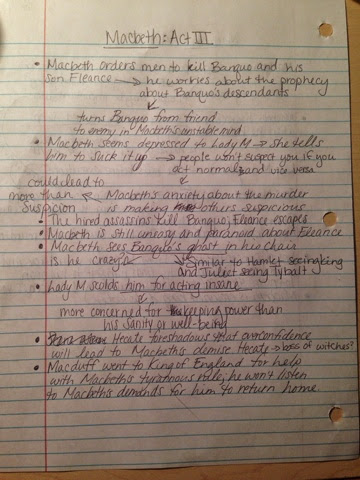
When Lady Macbeth hears of the prophecy that Macbeth will become king, she is enthusiastic and wants to kill the king himself. The audience sees Lady Macbeth as a power hungry individual, while Macbeth, blinded by his love for her thinks that she just wants the best for him, which she convinces him is to become king of Scotland. The audience sees her planning the visit from the king, and worrying over Macbeth's possible lack of inner strength that he needs in order to murder the king and take the crown for himself with Lady Macbeth at his side. Macbeth seems meek about confronting the wife whom he loves and standing up to her to say that he doesn't want to kill his cousin who has recently put all of this responsibility, trust, and honor on Macbeth's shoulders by giving him the title of the Thane of Cawdor.
Wednesday, April 2, 2014
MACBETH ACT I ACTIVE READING NOTES
Act 1 Notes:

There was some glitch because I posted this last week, but it doesn't appear on my blog on the computer, only on my phone.
Monday, March 31, 2014
MEET MACBETH
In the beginning of the play, Macbeth is introduced through indirect characterization as this heroic figure in battle and a great killer for his country. This is revealed in a story of a battle that a visitor is describing to the king of Scotland, Duncan. Three witches foreshadow through their predictions of the fortunes of Macbeth and his cousin Banquo. They say that Macbeth will be a thane of Cawdor, and then, he will be king, while Banquo's children will be children. They basically give away the ending of the play, but they do not give away the means by which all of this occurs, which is the real story. Shakespeare's exposition includes characters like the witches and minor attendants who can make comments about Macbeth or his future, foreshadowing Macbeth's destiny and explaining his personality, but not foreshadowing the details of the play, only enough to keep the audience on their toes.
LITERATURE ANALYSIS #3
1. For this literature analysis, I read The Memory Keeper's Daughter by Kimberly Edwards. The story is a bout a doctor who is forced to deliver his twins because of snowy weather. The second child, however, is a girl with Down syndrome. The year is 1964, and the doctor asks the nurse, who has had a crush on him for the longest time, to take the baby to an institution he knows of before his wife wakes up from the gas she is on to help with the pain of labor. It is revealed in a flashback that the doctor had a sister with Down syndrome who he idealized but who died young, and the doctor didn't want his wife or the first twin, his son, to go through that pain, and he didn't want to go through that pain again. The story then switches point of view from Doctor Henry to the nurse, Caroline Gill, who takes the baby to the recommended institution but can't bring herself to give the newborn away when she meets the people that work there and sees how they treat the "patients." Caroline, without really thinking about what she is doing, takes the baby back to her apartment, making friends with a trucker along the way. After a couple of days, she finds out that Dr. Henry told his wife, Norah, that their daughter, Phoebe, had died, and Mrs. Henry is having a memorial service for their dead daughter, who is really in the dresser drawer in Caroline's apartment. Caroline tells Dr. Henry that she kept the child and he gets angry. Caroline quits her job and cuts all ties with her life in that town and moves to Pittsburgh with Phoebe. The rest of the book takes snapshots of the lives of Paul, the first twin, and Phoebe, comparing their growth and development at a couple of months old, one year old, six years old, thirteen years old, eighteen years old, twenty-four years old, and twenty-five years old. The point of view was changed from character to character. In the end, (spoiler alert!) David dies suddenly of a heart attack after splitting up with Norah but before he tells her that Phoebe is still alive. When Paul and Phoebe are twenty-five years old, Caroline Gill comes to Norah and tells her that Phoebe is alive. The book ends with Paul and Phoebe bonding by singing at their father's grave, Paul putting the past behind and moving forward after spending years angry and resentful at his father and his life.
Wednesday, March 26, 2014
MY MACBETH RESOURCES
1. The analysis and summary of Macbeth available on Shmoop.
2. Sparknotes, of course, has similar content on Macbeth as Shmoop, except here Sparknotes provides a modern translation of Shakespeare's old-fashioned language for the play.
3. If you are really intrigued by Macbeth, you can spend three hours of your time watching this Macbeth movie starring Patrick Stewart as Macbeth.
4. There is also a Thug Notes video on Macbeth where the narrator attempts to give a summary and short analysis of Macbeth in an entertaining way in hopes of making it easier to remember the complicated plot of the play.
5. This is a video that answers 10 questions about some confusing or thought-provoking topics in Macbeth.
2. Sparknotes, of course, has similar content on Macbeth as Shmoop, except here Sparknotes provides a modern translation of Shakespeare's old-fashioned language for the play.
3. If you are really intrigued by Macbeth, you can spend three hours of your time watching this Macbeth movie starring Patrick Stewart as Macbeth.
4. There is also a Thug Notes video on Macbeth where the narrator attempts to give a summary and short analysis of Macbeth in an entertaining way in hopes of making it easier to remember the complicated plot of the play.
5. This is a video that answers 10 questions about some confusing or thought-provoking topics in Macbeth.
Tuesday, March 25, 2014
Masterpiece Test (Benchmark)
I guess I will go over the basics of genetics in this post. Genetic material comes in the form of DNA or RNA. DNA and RNA differ by the type of sugar uses in the structure of their backbone. DNA uses deoxyribose and RNA uses ribose. DNA is in the form of a double helix with two sugar and phosphate strands connected by a pair of nucleotide bases. The possible nucleotides of DNA are adenine, thymine, cytosine, and guanine. These are usually just represented by the first letter of each of the nucleotides: A, T, C, G. Because of their individual structures, adenine will always pair with thymine, and cytosine will always pair with guanine. Genes are certain nucleotide sequences of DNA or RNA that could consist or hundreds or thousands if base pairs. This leads me to genetics, the study of genes, which is the topic of my masterpiece and which I will elaborate on in future posts.
Monday, March 24, 2014
HUXLEY'S BRAVE NEW WORLD
After watching the interview between Mike Wallace and Aldous Huxley, I have a lot more respect for Huxley and what he must have faced in regard to public opinion about his idea of what society could be like in the future in Brave New World. During the interview, Mike Wallace's tone when he asked some of his questions was skeptical when Aldous Huxley warned against our uses of technology. It changed my perspective on the novel because I fully realized how radical Aldous Huxley's concept of a future society was in Brave New World.
Thursday, March 13, 2014
Resource(s) of the Day (AP Physics)
We are covering a challenging unit in physics class right now, so each student in the class came up with two resources that help to explain and clarify some of the confusing and closely interrelated terms. Here are mine:
A video by Derek Owens on electric potential and potential difference, he has some great videos that explain physics concepts and give examples. The link is to one of a couple of videos he has that teach electric potential and voltage.
An AP Central CollegeBoard document that discusses electrostatics. Electric potential energy and electric potential are explained starting on page 13.
A video by Derek Owens on electric potential and potential difference, he has some great videos that explain physics concepts and give examples. The link is to one of a couple of videos he has that teach electric potential and voltage.
An AP Central CollegeBoard document that discusses electrostatics. Electric potential energy and electric potential are explained starting on page 13.
Monday, March 10, 2014
One (Wo)Man's Trash Is Another (Wo)Man's Treasure #2
This is the second post where I have focused on the re-purposing of unwanted materials or trash into useful items. Here is the first post.
I can't remember how I stumbled upon this, but this blog mentioned a jeweler named Margaux Lange who uses salvaged Barbie doll parts to create her jewelry! I have to say it's not my style, but I think that it's really interesting and creative. Check out Margaux Lange's website here to see her Barbie jewelry in the form of necklaces, bracelets, earrings, rings, and brooches! Meanwhile, here are some sample pictures of her jewelry:


I can't remember how I stumbled upon this, but this blog mentioned a jeweler named Margaux Lange who uses salvaged Barbie doll parts to create her jewelry! I have to say it's not my style, but I think that it's really interesting and creative. Check out Margaux Lange's website here to see her Barbie jewelry in the form of necklaces, bracelets, earrings, rings, and brooches! Meanwhile, here are some sample pictures of her jewelry:
Subscribe to:
Posts (Atom)